
Landing Gear Design Using Embedded CATIA Tool
•Reducing Landing Gear Weight
•Embedded CATIA Tool
The Citation CJ2 business jet, formally introduced in October 1998 at the National Business Aviation Association (NBAA) convention in Las Vegas, NV, is a bigger, faster version of Cessna's CitationJet. The CJ2 features a longer cabin and tail cone to carry more passengers and baggage, a greater wingspan, a larger swept horizontal tail, new Williams-Rolls FJ44-2C engines, and advanced technology Collins Pro Line 21 avionics.
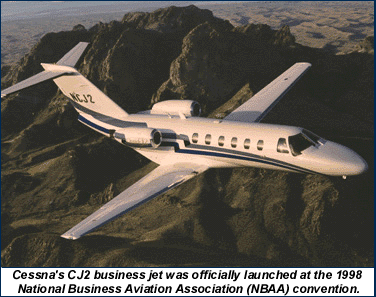
Much of the CJ2's performance and economy is due to its natural laminar-flow wing, which greatly reduces drag. This wing maintains a smooth, uninterrupted flow of air across a much greater portion of its surface compared to a conventional wing.
In the design of the main landing gear trunnion for the CJ2, engineers had to carefully balance the dual design objectives of meeting fatigue requirements while reducing weight. It was important to keep stress levels low in critical areas of the part, such as the actuator lug, to insure long fatigue lives. It also was important that these areas were not "overdesigned," because that would add extra weight to the plane. A lighter plane allows for larger payload and better fuel economy.
In the past, engineers would have analyzed the part by performing a stress analysis using stand-alone FEA software. Areas that show particularly low stresses are areas where excess material may be present. From a translated CATIA model of the part, an engineer created a finite element model, manually fine-tuning the analysis mesh repeatedly in areas where the geometry was complicated.
For a first iteration on a concept model, setting up the analysis and getting results took up to two weeks. If the results indicated excess weight in a certain area, the designer would change the CATIA model, give it back to the engineer, and the process was repeated. It did not take as long for the second and successive iterations because some aspects of the original analysis model were re-used. But the new geometry always had to be re-meshed and that was the most time-consuming part of the analysis process. The long turnaround time limited the number of optimization steps that could be tested and still maintain design schedules.
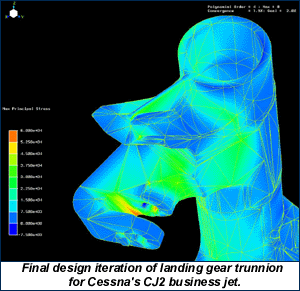
To get a faster turnaround on stress analysis, Cessna engineers added an integrated structural analysis program called PolyFEM from LMS CADSI (Coralville, IA). PolyFEM runs within CATIA and automatically meshes and analyzes the CATIA solid models, eliminating the process of manually creating and fine-tuning the mesh. Since all parts at Cessna are created as solids within CATIA, PolyFEM's integration made it a very useful tool.
PolyFEM uses a p-element adaptive solver that uses high order polynomials as the basis functions to approximate the solution. The solution algorithm is adaptive based on problem size and available machine resources to produce the best results in the shortest amount of time with no user intervention. The maximum order of the basis functions (p-order) can be progressively increased to obtain the desired convergence without remeshing.
The landing gear trunnion was modeled in CATIA by a design engineer who provided the CATIA model to a structural engineer for analysis. After applying loads, constraints, and material properties to the solid within CATIA, PolyFEM then automatically meshed the solid, created the solution, and initiated PolyFEM's post-processing window. The software's automatic mesher is capable of automatically using tetrahedral (tets), pentahedral (wedges), and hexahedral (bricks) elements whenever each is appropriate.
To determine the loads to apply to the part, the engineer created a simple stick model in NASTRAN and ran an analysis to determine overall loads on the landing gear. This was a very coarse model that didn't show stress concentrations in fillets or areas around fittings. It provided just the basic reaction loads into the trunnion that were then applied to the PolyFEM model. After the engineer specified boundary conditions, material properties, and constraints, the analysis was ready to run. The entire process took about a half a day.
Results of the first analysis indicated areas of low stresses where excess material was likely to be present. The design engineers modified the CATIA model to remove some material and asked the engineer to check it again. Provided none of the loaded/constrained surfaces change, all the engineer had to do was restart the analysis, because the PolyFEM boundary conditions and material properties are mapped to surfaces of the CATIA solid. Since PolyFEM uses the exact CATIA model, the solution to the next iteration was ready in about an hour. In this case, the landing gear trunnion was optimized in about two weeks. With PolyFEM, once the geometry of the part was changed in CATIA, it was immediately ready for another analysis.
In all, the landing gear trunnion design went through about 10 iterations. The design engineers did things like changing fillet radii and reducing material thickness, each time using PolyFEM to make sure that in their attempts to reduce weight they did not exceed stress levels on the part necessary for good fatigue life.
Edited by David Robb
For more Information:
Cessna Aircraft Company, Mid-Continent Facility (Corporate Offices, Aircraft Marketing, Engineering, Manufacturing), P.O. Box 7704, 67277-7704, 1 Cessna Blvd., 67215, Wichita, KS. 316-517-6000.
LMS CADSI, 2651 Crosspark Rd, Coralville, IA 52241, 319-626-6700, fax 319-626-3488, email: marketing@lmscadsi.com, www.lmscadsi.com